2026 WaiMaths Competition Practice Questions
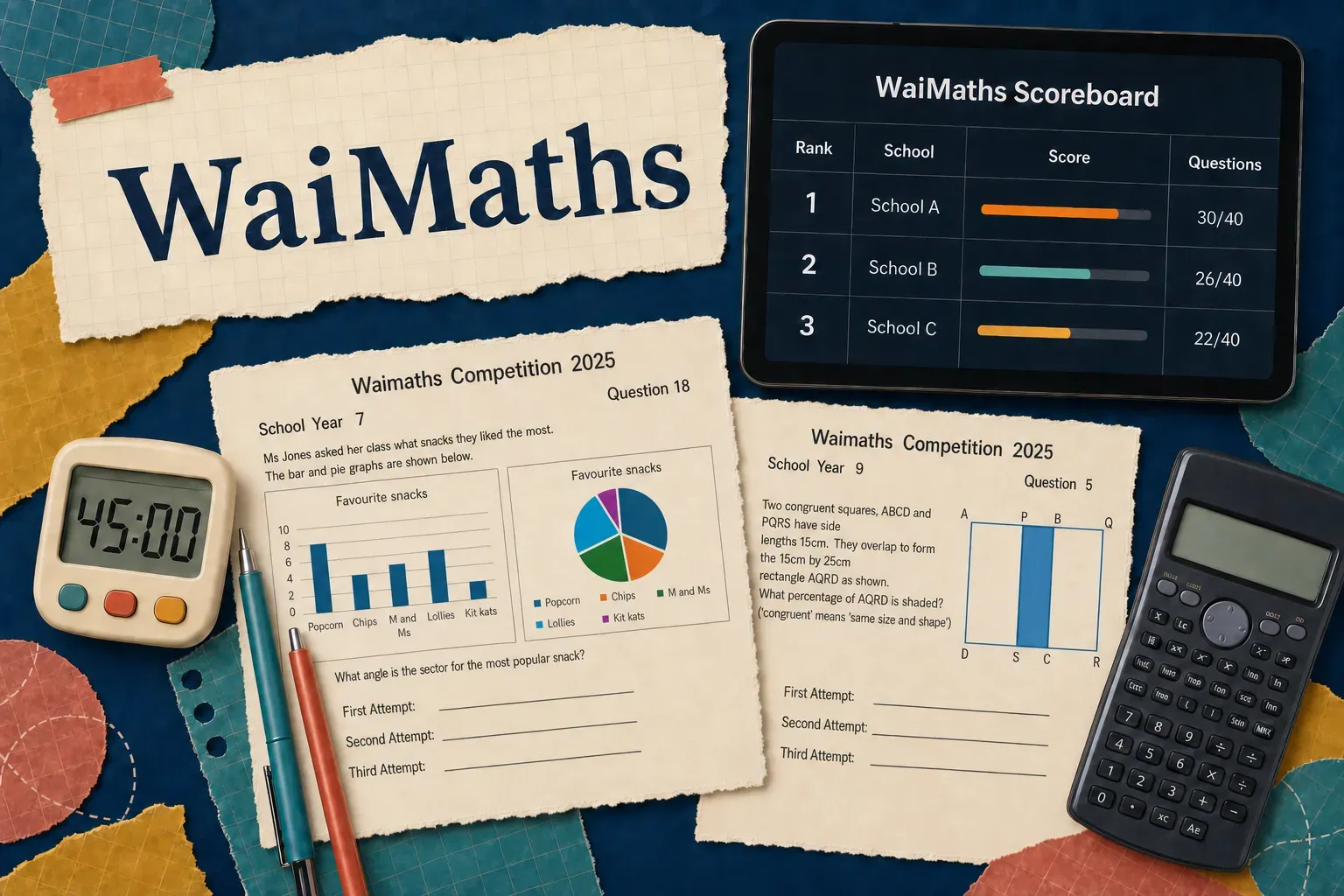
What is WaiMaths?
On Thursday 13th August 2026, the annual Waikato Maths Association WaiMaths competition will be held at Hamilton Boys' High School. This annual competition has been a highlight of the maths calendar for over 30 years!
In Term 3, Year 7 to Year 11 students from schools across Waikato, New Zealand compete in teams of three to solve 20 tricky maths problems in 45 minutes. Year 7–8 teams work with paper and pen only—calculators are only allows for year 9–11 teams.
To succeed, students must demonstrate rapid mental maths skills, creative problem-solving, excellent teamwork, and strategic decision-making—knowing when to skip difficult questions can be just as crucial as solving them!
How to prepare?
The best preparation begins with the whole curriculum for your year level—not only the topics that usually appear in competition practice.
WaiMaths questions can draw on Number, Algebra, Measurement, Geometry, Statistics, and Probability. Make a checklist of the learning outcomes for your year and identify any gaps. Every question should be solvable by a student who has learned the knowledge and skills in that year's curriculum; the challenge is recognising which skills to use and combining them in an unfamiliar situation.
Manatoa helps turn this checklist into a practical plan. Activities are organised by curriculum topic, and each student's saved results make it easier to see which knowledge and skills are secure and where the gaps are. Students can then return to easier practice problems for a particular skill before attempting mixed or competition-level questions.
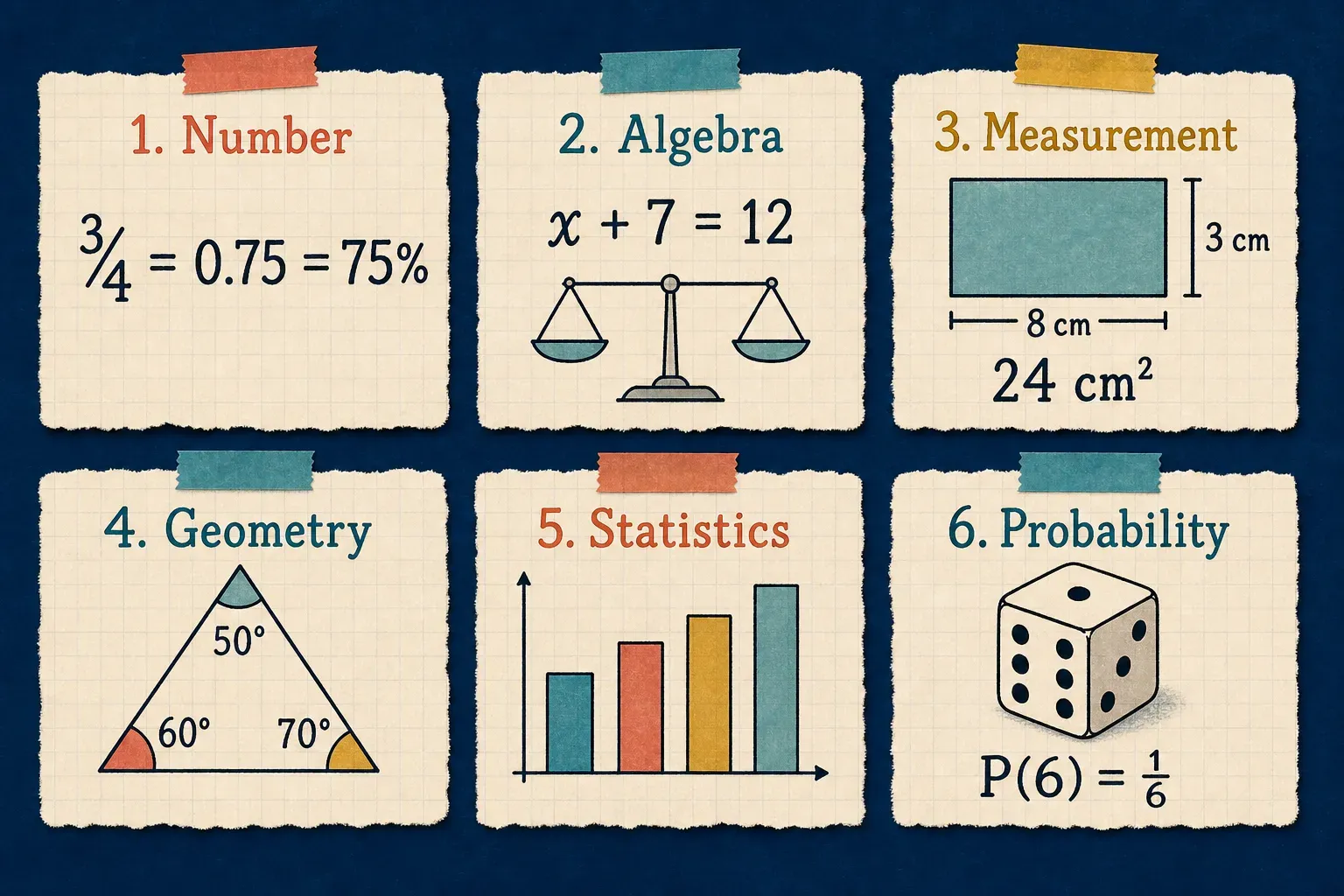
Step 1: Practise one skill at a time
Begin with single-step word problems that focus on one learning outcome. For example, practise finding a percentage of an amount before trying a problem that combines percentages with measurement or money.
Work through every curriculum strand this way. A student should be able to recognise the skill in context, choose the correct operation or method, and understand why it works.
For Years 7–8, examples from each strand include:
| Strand | Year 7 | Year 8 |
|---|---|---|
| Number | Powers of 10, HCF and LCM, square roots, integers, fractions, decimals, percentages, and proportional reasoning | Prime factorisation, cube numbers, decimal multiplication, more complex fraction operations, divisibility rules, and financial planning |
| Algebra | Forming and solving one-step equations, substituting values into expressions, describing linear patterns | Two-step equations, simplifying expressions with brackets, writing equations for linear patterns |
| Measurement | Metric conversions, speed from distance and time, duration problems, perimeter and area of composite shapes | Finding distance or time from speed, converting square units, finding volume of triangular and composite prisms |
| Geometry | Angle relationships, plan views of 3D shapes, resizing 2D shapes, coordinates, compass directions | Reasoning with polygon angles, prism nets, invariant properties under transformations, map scales, distance, and turns |
| Statistics | Planning investigations, creating data visualisations, describing distributions, checking whether claims are supported by data | Comparing multiple visualisations, evaluating data-collection methods, and evaluating conclusions drawn |
| Probability | Listing possible outcomes, conducting experiments, estimating probabilities, and comparing experimental/theoretical results | Developing and evaluating probability models, justifying claims using evidence |
By working working through all the learning outcomes for their year level students will have all of the knowledge they need to answer each question in the WaiMaths quiz.
Step 2: Build up to multi-step problems
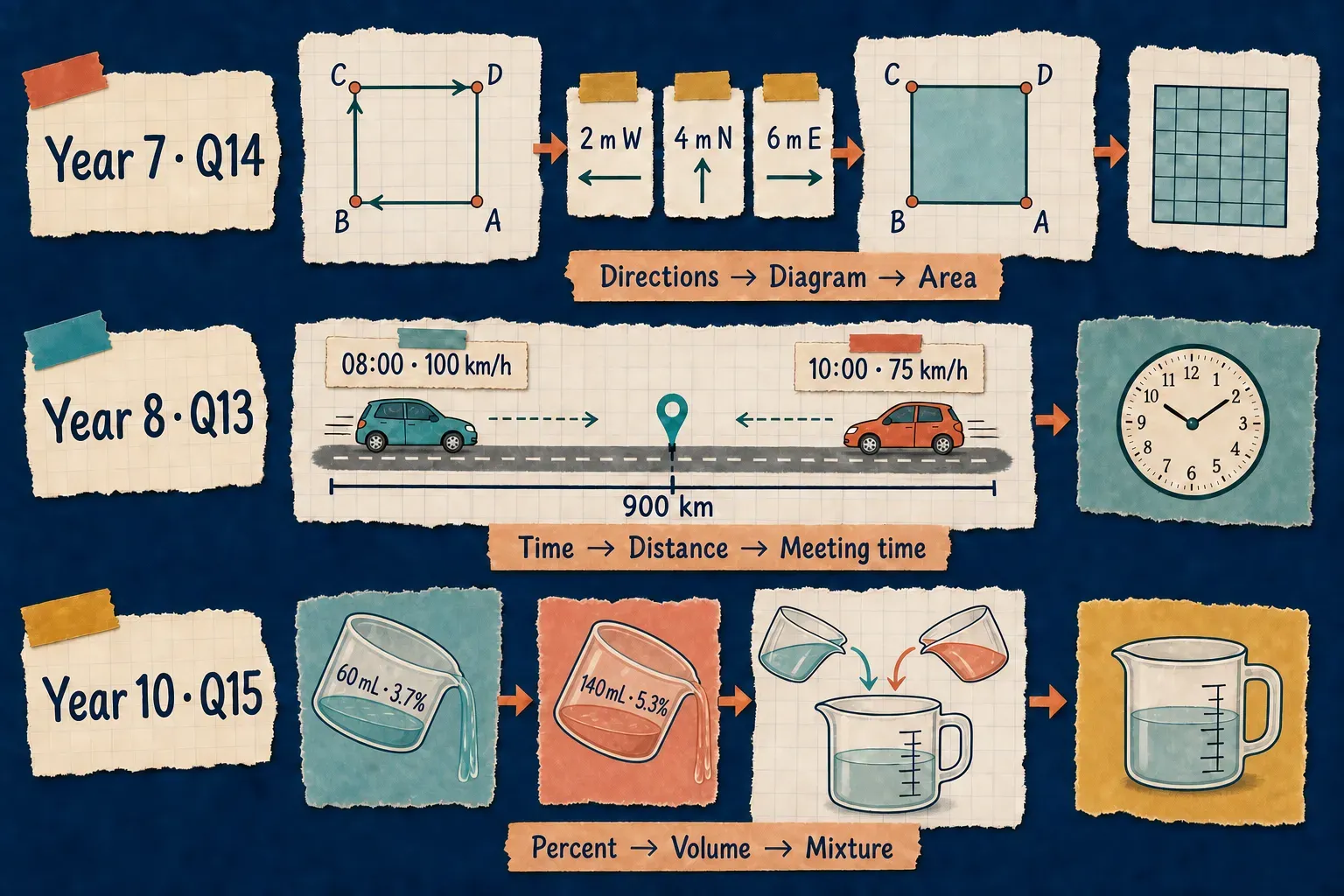
Once the individual skills are secure, start combining them. Move from two-step problems using one skill to multi-step problems that require several skills from different strands.
At WaiMaths level, the method is rarely announced. Students may need to draw a diagram, organise information in a table, notice a pattern, work backwards, eliminate possibilities, or try a simpler case before they can see what to calculate. Build towards complete competition problem sets, then practise them under time pressure with a team.
Preparing for Years 7–8
Calculators are not allowed in the Year 7 and Year 8 competition, so students need to calculate quickly and accurately without one. Slow arithmetic uses up time and attention that should be available for problem-solving.
Step 3: Make mental maths automatic
Students should be fast and confident with:
- addition and subtraction facts, including mental strategies for one- and two-digit numbers
- multiplication and related division facts through
12 × 12 - place value, rounding, estimation, factors, multiples, and divisibility rules
- common fraction, decimal, and percentage equivalents
- simple calculations such as a fraction of a whole number or a percentage of an amount
Manatoa's timed Mental Maths practice develops these skills in short question sets. It covers number sequence and order, place value, fractions, decimals, basic facts, factors, and multiples. Immediate feedback and saved results help students improve both speed and accuracy.

Step 4: Become fluent with written algorithms
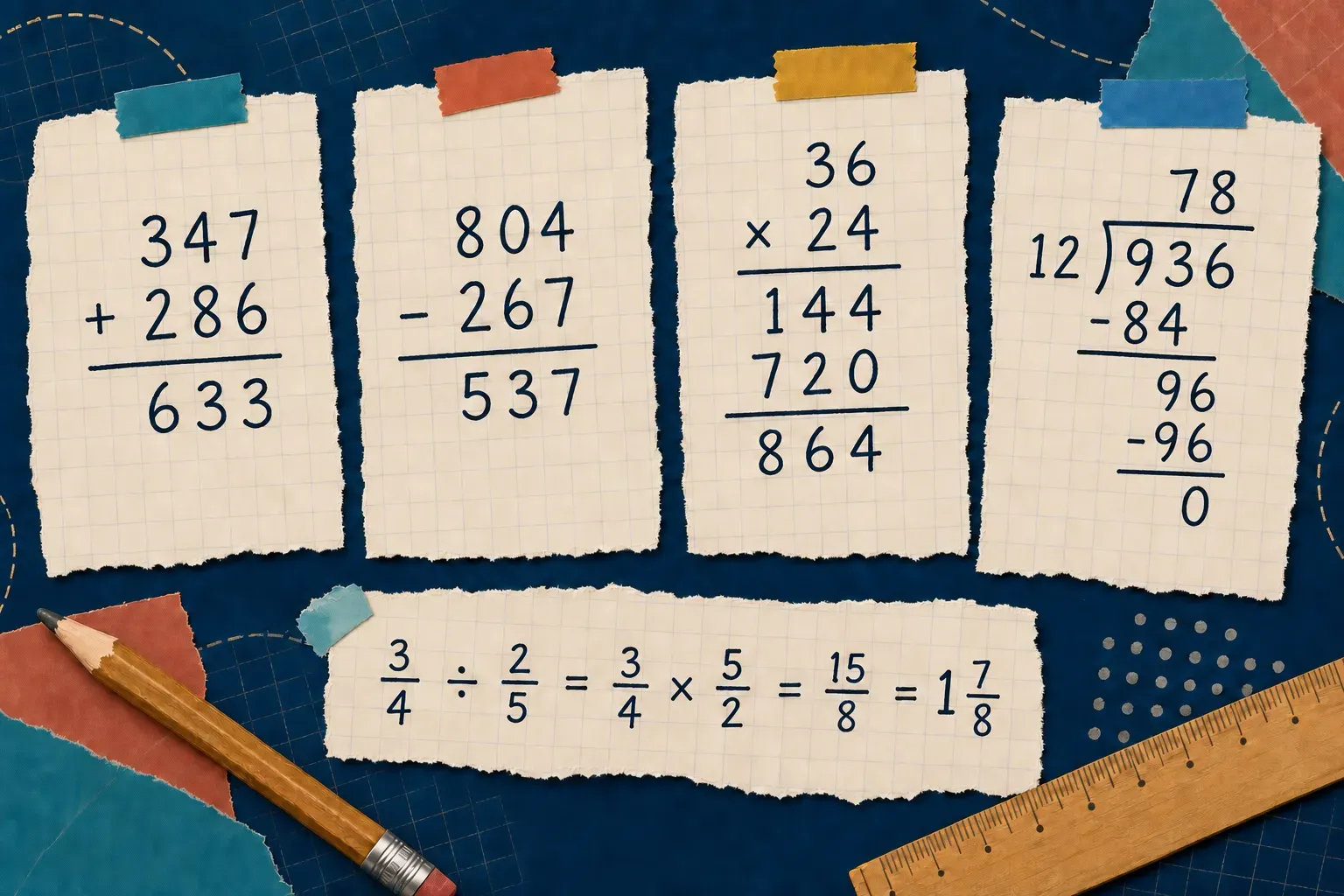
Mental strategies will not always be the quickest or most reliable choice. Year 7–8 students should also be able to set out standard written methods neatly and use them without hesitation:
- column addition and subtraction with regrouping
- long multiplication for multi-digit whole numbers and decimals
- short and long division, including interpreting remainders
- adding and subtracting fractions using a common denominator
- multiplying fractions and dividing by multiplying by the reciprocal
- calculating with decimals and percentages, including converting between fractions, decimals, and percentages
Students should also estimate first and check whether an answer is reasonable. A well-practised algorithm is useful only when the student has chosen the right operation and can spot a misplaced digit or decimal point.
Preparing for Years 9–11
Calculators are allowed for Years 9–11, but they do not decide what a problem means or which mathematics to use. Students still need secure number sense and algebraic fluency so they can enter calculations efficiently, rearrange expressions, estimate answers, and notice an unreasonable result.
Start with the same curriculum-coverage checklist and single-skill word problems, then combine the more advanced learning from that year level. Give particular attention to problems that connect number and algebra with measurement, geometry, statistics, or probability. Practise deciding what information matters, selecting a formula or strategy, and recording enough working that another team member can check it quickly.
The final step: Build a large bank of experience
Practise many different mathematical properties, representations, and problem types—not just small variations of the same question.
The more varied problems students solve, the more experience they have to draw on when a new problem looks unfamiliar. Creative problem-solving is often the ability to recognise that an idea from a previously encountered problem can be adapted and combined with something else.
Practise on Manatoa Maths
We’re collaborating with the Waikato Maths Association to make WaiMaths preparation available in an interactive format that saves progress. Manatoa currently includes:
- interactive past WaiMaths competition problem sets for every year level from Year 7 to Year 11, with 20 questions in each set
- easier word problems arranged by curriculum topic, so students can secure one skill before moving to mixed and multi-step problems
- timed mental maths practice for number order, place value, fractions, decimals, basic facts, factors, and multiples
- progress tracking so students and teachers can see completed practice, accuracy, and areas that need more work
Available past problem sets
- Year 7: 2012–2020 and 2022–2025
- Year 8: 2018, 2020 and 2022–2025
- Year 9: 2006–2010, 2018, 2020 and 2022–2025
- Year 10: 2018, 2020 and 2022–2025
- Year 11: 2010–2015, 2018 and 2021–2025
We are trying to help the Waikato Maths Association track down all the old problem sets from the past 30 years. If you have any other WaiMaths problem sets that you can share with us, please email mike@manatoa.nz.
All WaiMaths practice resources are freely available to member schools of the Waikato Maths Association.
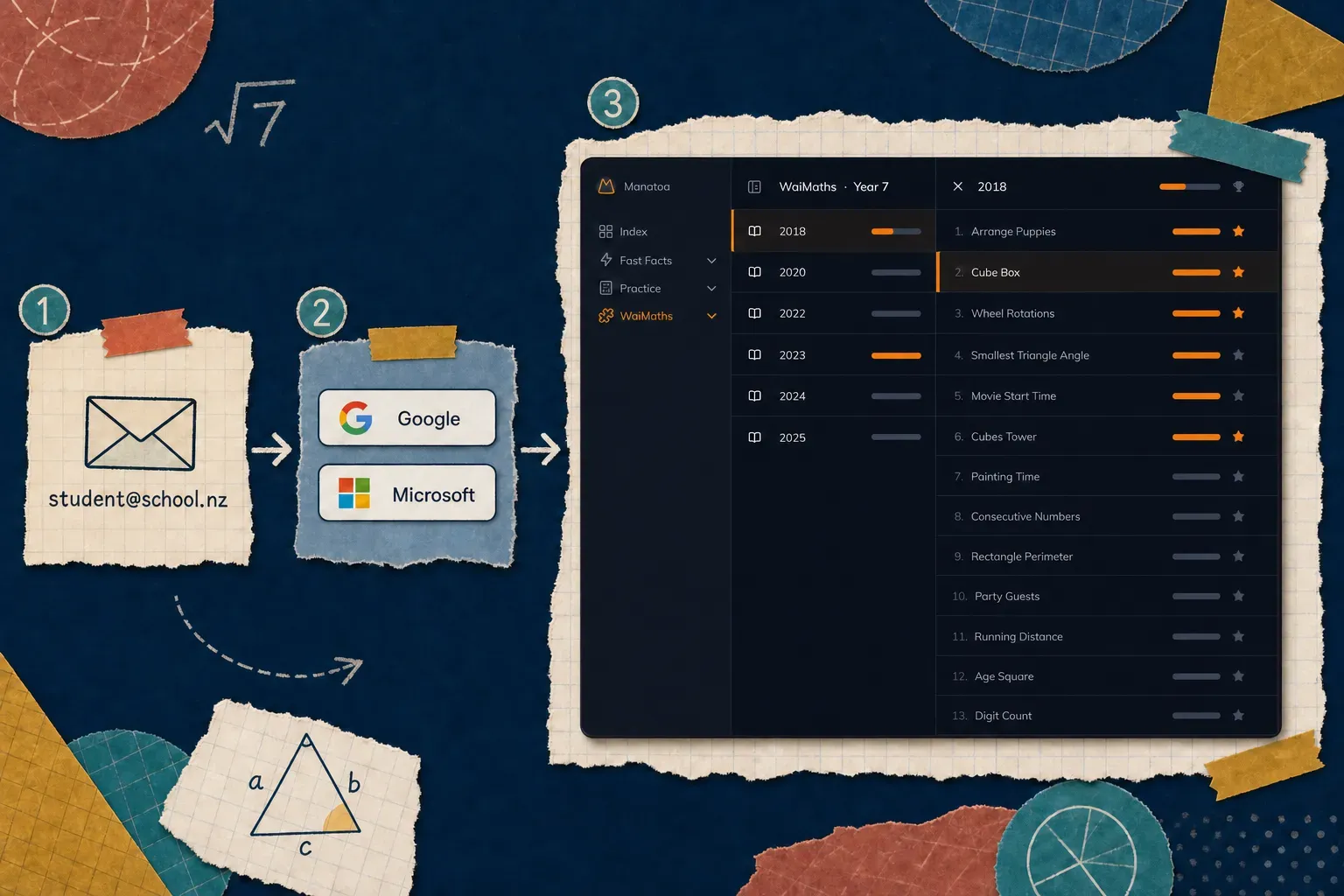
How to sign up
- Go to the Manatoa Maths sign-in page.
- Choose Google or Microsoft and sign in with your New Zealand school email address. There is no separate username or password to create.
- Open WaiMaths, choose your year level, and select a competition set or an easier topic-based activity.
- Start practising. Manatoa saves your results so you can return later and keep building your progress.
Using Manatoa with classes
If only one class is using Manatoa, no teacher setup is required. Students can sign in with their school accounts and begin practising immediately.
For several classes, it is worth setting up separate class groups so progress can be monitored clearly. One teacher can request administrator access and set up all the school's classes, or each teacher can request teacher access and manage their own class. This keeps each teacher's progress reports focused on the students they teach.